
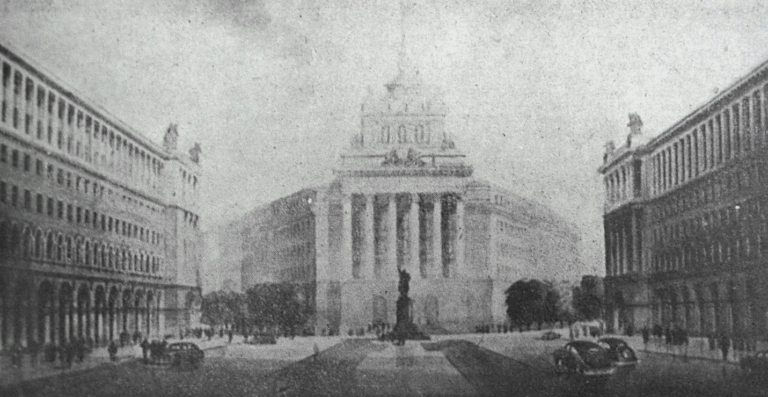
The “Largo” in Sofia is the signature landmark of Stalinist urbanism in Bulgaria. Yet, it also visualizes the gap between political planning and urban planning under state socialism. From this perspective, Largo emerges as the greatest failure of socialist architecture in Sofia, even if today, in hindsight, it is seen as the embodiment of socialism’s characteristic architectural imagery. In its own time, it was celebrated as an achievement for only a brief period, which came to an abrupt end shortly after Largo’s delayed completion and official inauguration in 1957. Once de-Stalinization swept through the field of construction, Largo — alongside similar ensembles across the Eastern Bloc, from East Berlin’s Stalinallee to Warsaw’s Palace of Culture and Science — became a textbook image of everything now rejected as ideologically flawed in Stalinist urban aesthetics: a marble-and-granite embodiment of the denounced cult of personality. Yet, even before its aesthetic rejection, Largo was not exactly a design success. From its very conception, it complicated enormously the grand task of Sofia’s “socialist reconstruction” and ultimately turned it into a puzzle that successive generations of urbanists could not solve.
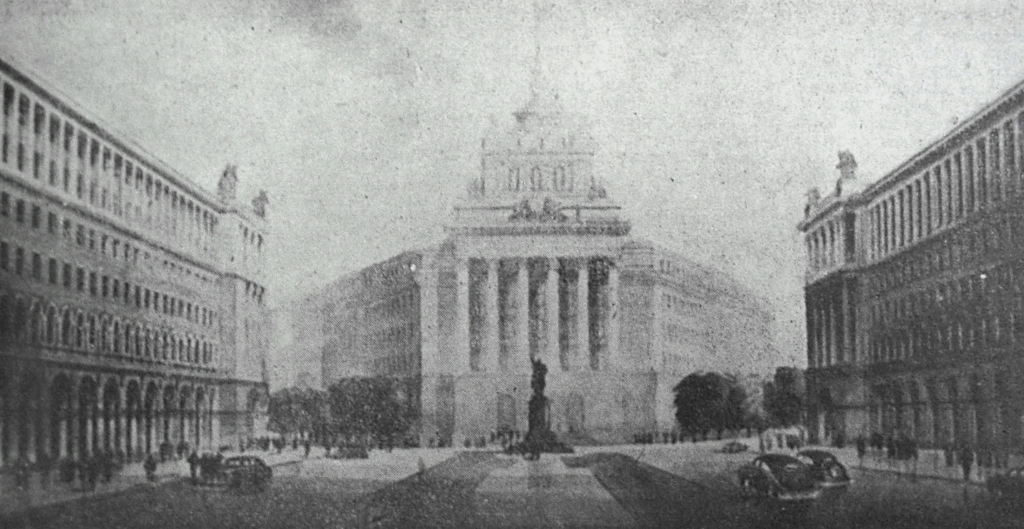
Largo ensemble: the Party House at the center with a planned, yet unbuilt statue of Lenin, flanked by the Ministry of Heavy Industry (left) and the Ministry of Electrification (right)
Source: Nauka i tehnika za mladezhta 9/1953: 1
How Largo Emerged from the Postwar Planning Process
Immediately after the communist-led coup of 9 September 1944, the “socialist reconstruction” of Sofia kickstarted leaving its mark not only on the urban fabric but also on the city’s governance structures and professional organizations. The very first step was the postwar master plan of 1945, part of the large-scale reconstruction effort. With a decidedly Marxist ambition, the plan aimed to “level the differences” between center and periphery — the latter described by the plan’s author, Lyuben Tonev, as “monotonous and grey — abandoned to sprawl endlessly, lost in mud, misery and lack of basic living conditions”. The approval of Tonev’s plan launched a lengthy cycle of planning competitions, all still nominally focused on postwar reconstruction. Ironically, all of them concentrated on the center rather than the periphery.
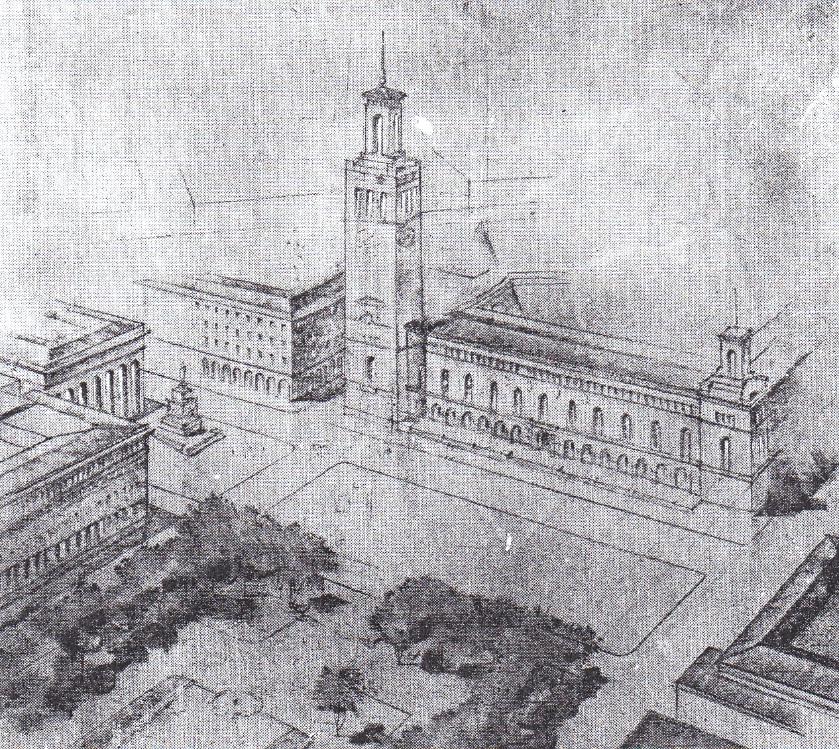
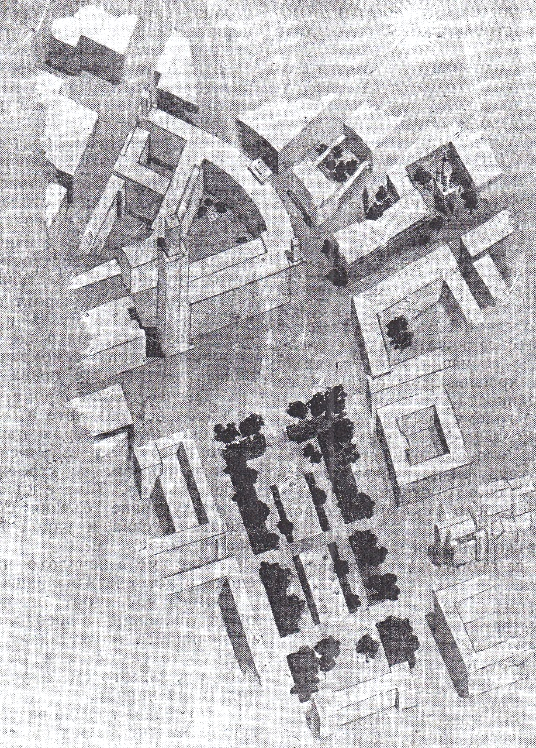
The plan for the center from March 1947 with a new edifice on the spot of the former royal palace facing the City Garden
Source: Arhitektura 10/1947: 4-5
As the delineation of the center kept expanding from one competition to the next, the process gradually gave birth to the Largo. Meanwhile, the original impetus — solving the housing crisis and improving living conditions — was quietly sidelined until it was all but forgotten. Viewed against the social urgency that had motivated the replanning of Sofia’s center, Largo epitomized a failure of postwar reconstruction: not an error, but a deliberate redirection of resources, financial and technical, from an “acute social problem” – as the Town Council itself called the postwar housing situation in Sofia – to a project of political prestige.
Largo’s construction began in 1948 with the Party House, headquarters of the Central Committee of the Bulgarian Communist Party. It was preceded by a series of competitions for a detailed plan of the center, none of which produced a winner. Though the boundaries of the center shifted with each competition, all briefs consistently focused on the area around the former royal palace. The palace had been earmarked for demolition by Tonev’s master plan and had been gradually encroached upon through a series of symbolic gestures dismantling the monarchy.
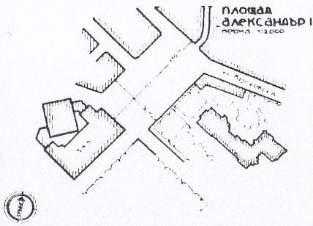
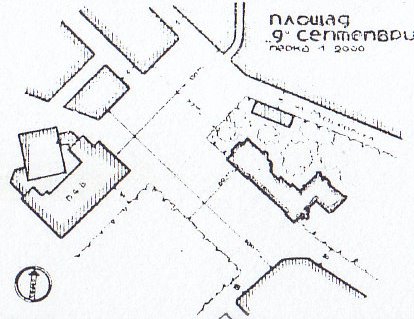
The replanning of the area around the palace and its transformation from the rectangular Alexander I Sq northwest from the palace (left-side plan) into 9 September Sq with an irregular L-shape (right-side plan) by removing the fences and opening up the palace park – according to Tonev’s master plan of 1945
Source: Lyuben Tonev, Ploshtadat (Sofia: Pechatnitsa na BAN, 1949)
In 1946, following the referendum that transformed Bulgaria from monarchy to republic, the palace’s fence, guardhouse, and auxiliary buildings were removed. Yet the palace itself still stood, awaiting a resolution for the main city square that had formed in front of it — now renamed “Ninth of September,” after the date of the 1944 coup. The plan for this square required a new building for the Council of Ministers on the site of the palace, but the irregular terrain posed serious technical challenges. While work stalled, party leadership assigned the construction of their headquarters along the western lines of the square without any regard for its ongoing replanning. The Party House’s own irregular shape and location further complicated an already difficult planning puzzle.
A year later, in 1949, another complicating factor was added: the Mausoleum of Georgi Dimitrov, designed overnight and erected in the course of a week along the southern lines of Ninth of September Square, facing the palace.
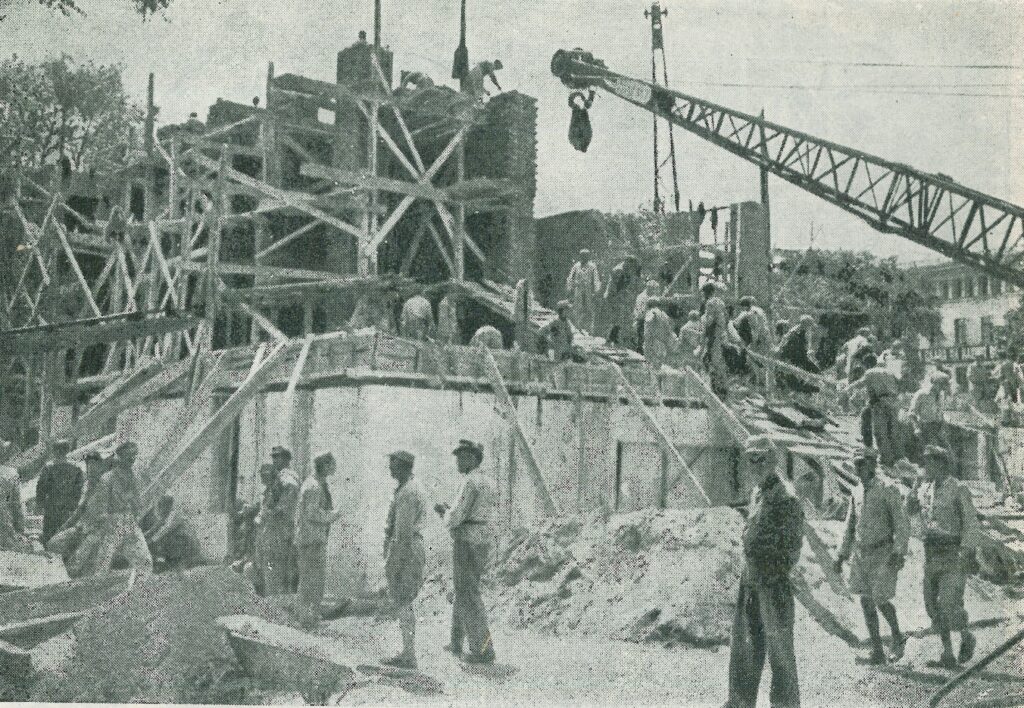
Shock-work construction of the Mausoleum of Georgi Dimitrov
Source: Serdika 1-2/1950: 44
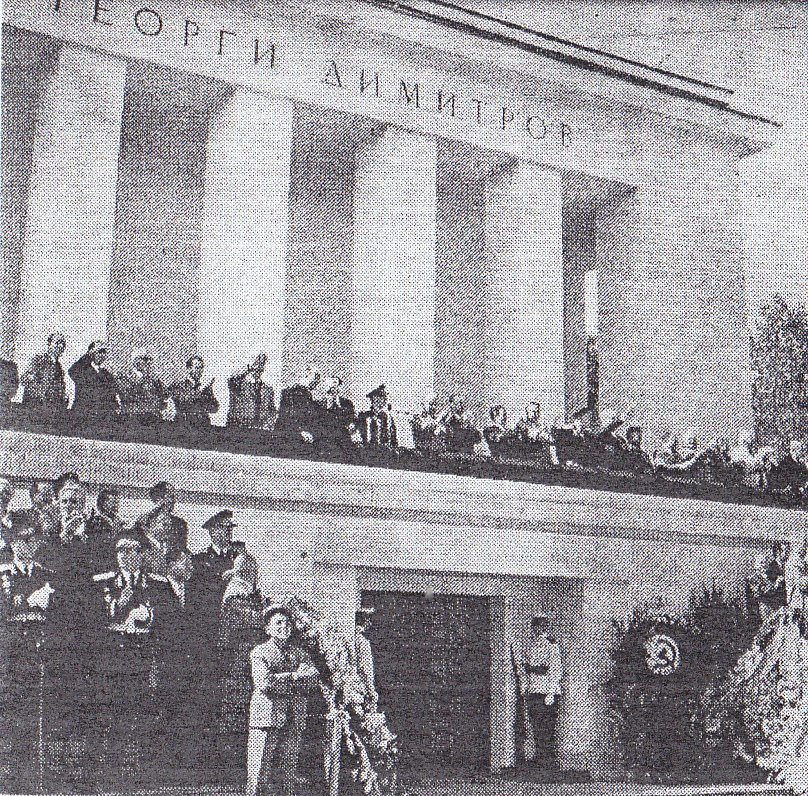
The Mausoleum of Georgi Dimitrov during a mass parade with the party leadership on the tribune
Source: Sofiya 10/1959: 4
This was yet another high-profile construction project running ahead of planning. Ironically, all these piecemeal interventions in the central area would save the royal palace from demolition — it still stands today, housing the National Ethnographic Museum.
In 1950, the government commissioned a new plan linking the pending Ninth of September Square with the future Council of Ministers building and the area around the Party House already under construction. It was this assignment that invented the Largo as new assembly grounds, with the Party House at its center flanked by the two primary industrial ministries, a Central Department Store, and a representative hotel. Three additional buildings were envisioned but never built: a residential block for government employees, an opera house, and most ambitiously, a House of the Soviets [in the Bulgarian sense of “councils”] that would have faced and dwarfed the Party House, closing the Largo on the western side. Architectural projects for all the buildings were commissioned to centralized designer bureaus by governmental decree (dated 30 November 1951).
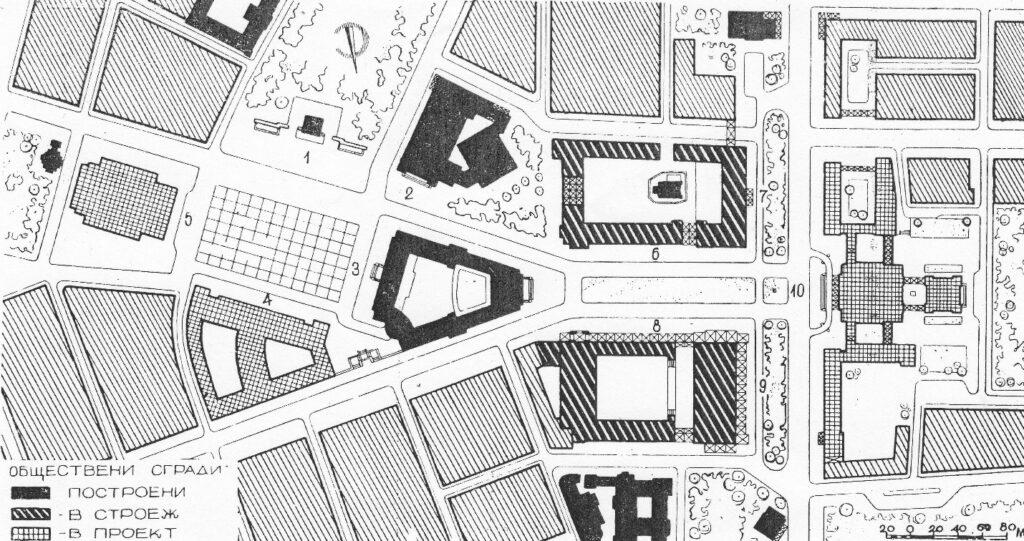
The plan of the central area (coloration of public buildings: black for completed; darker stripes for “under construction”; lighter stripes for “in project”; numbers: 1 Mausoleum; 2 Bulgarian People’s Bank; 3 Party House; 4 Council of Ministers; 5 Opera; 6 Ministry of Electrification; 7 Representative Hotel; 8 Ministry of Heavy Industry; 9 Central Department Store; 10 House of the Soviets
Source: Arhitektura 3-4/1954: 50
It is commonly assumed in Bulgaria — and often repeated by historians unfamiliar with urban history — that the Allied air raids of 1943–44 cleared the central area for new construction. While much of the area was indeed bombed, this is only partly accurate. Confidential governmental decrees list existing buildings that had to be demolished for Largo. Notably, several structures badly damaged by bombs had already been restored only to be slated for demolition again almost immediately. The initial demolition list included 24 multi-story buildings, mostly ferro-concrete constructions from the interwar period when the area was a busy commercial district, many with elevators and other amenities. Altogether, around 4,000 square meters of built space was sacrificed, and 113 families — over 400 people — were displaced. To put this in context: Sofia’s population had grown by more than 50% in the five years after the war, and housing construction lagged so far behind that newly built units could accommodate no more than 10% of newcomers. This stark contrast adds further weight to the argument that Largo represented a deliberate failure, or actually a betrayal of postwar reconstruction’s social mission.
How Largo Fit into the Institutional Process of Public Works
The planning of the city center following the decree of 1951 would become a test case for the newly centralized system of architectural management in which professionals were demoted to “technical cadres” allocated to state bureaus. Oversight of all these bureaus was concentrated in the Architecture Directorate at the Ministry of Communal Economy and Public Works. Centralized oversight not only failed to coordinate the 185 professionals involved in the planning enterprise but generated much friction among them — both vertically along the chain of command and horizontally between supposedly collaborating teams. At the root of this tension was the clash between technical rationality and political expediency.
This tension was already visible in the preceding years of planning: work alternated between protracted standstill — competitions ending without a winner, assignments reformulated and reissued — and frantic Stakhanovite acceleration, with projects drafted overnight and put into execution the next morning (as with the Party House and especially Dimitrov’s Mausoleum). This double tempo of standby and headlong rush was incompatible with any rational technical process, and as long as planning was organized in this top-down, heavily bureaucratized manner, failure was not a random setback but a systemic inevitability.
The schedule for designing and building Largo was tight from the outset: commissioned in November 1951, all plans were to be completed within a year, and construction finished by the end of 1954. The first delay came from the top. The Council of Ministers stalled for months before approving the preliminary documentation, and the Architecture Directorate — running out of time — began designing the buildings in violation of existing regulations before the parameters were finalized. Meanwhile the leveling plan for the entire area hit a wall as several ministries could not agree on it so a special governmental commission was set up just three and a half months before the project deadline. Architects were working while kept in the dark about crucial parameters, including the demolition lists.
Investors — a role assigned by the planned economy rather than chosen — proved another source of obstruction. While investors could not refuse an investment project, they could nevertheless delay it to spare resources for their regular annual plan. In the case of Largo, investors included three ministries, the Council of Ministers, and two further agencies. All of them dragged their feet, failing even to respond when asked to send experts to the planning teams. Difficult cooperation with investors was such a chronic problem that major planning organizations tracked man-hours wasted in such futile dealings in their annual reports. Yet planners showed the same indifference toward construction companies once they had submitted their projects. In a work process artificially fragmented among multiple sub-branches of the centralized administration, every organization reported only on its own plan fulfillment, with no incentive to care for the overall outcome. Architects rarely visited construction sites, let alone supervised implementation consistently, leaving technical errors unnoticed or identified too late, which only made construction longer and more expensive.
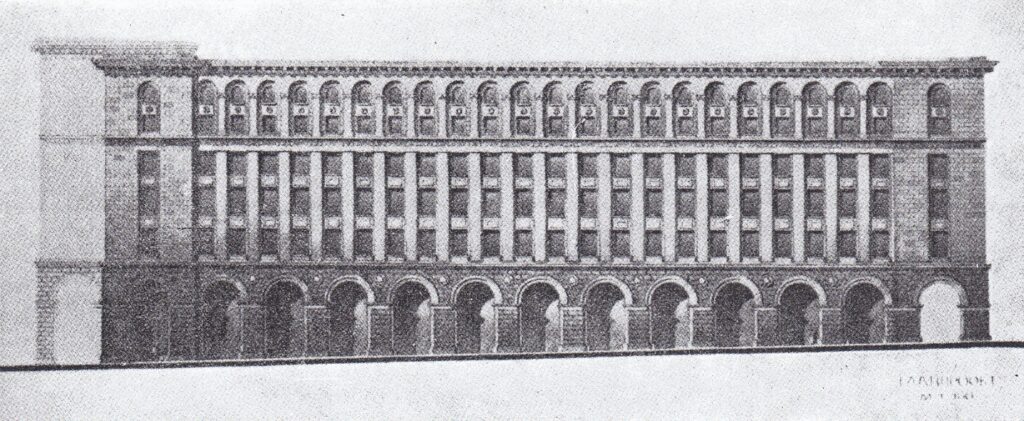
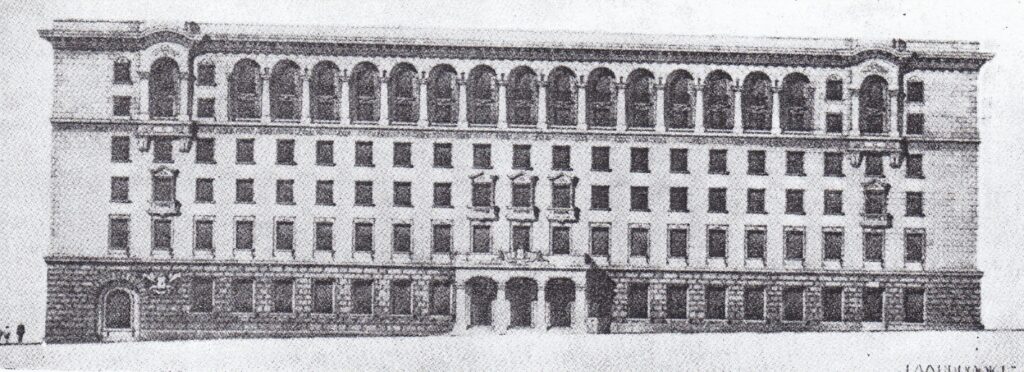
The facades of the two ministerial buildings with the Central Department Store and the hotel, respectively
Source: Arhitektura 5-6/1954: 4-5
The result was cascading failure. The entire Ninth of September Square, along with three adjacent buildings, simply fell out of the construction program — first falling behind Largo, then grinding to a halt.
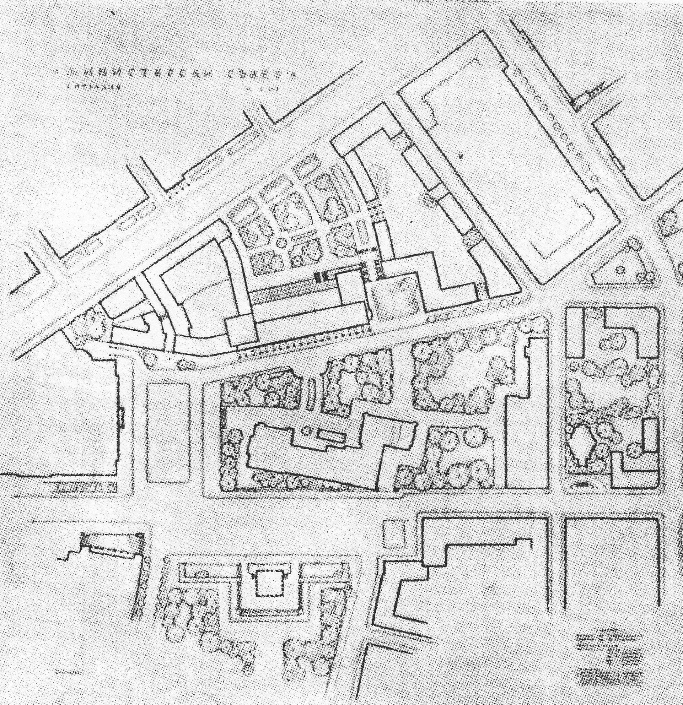
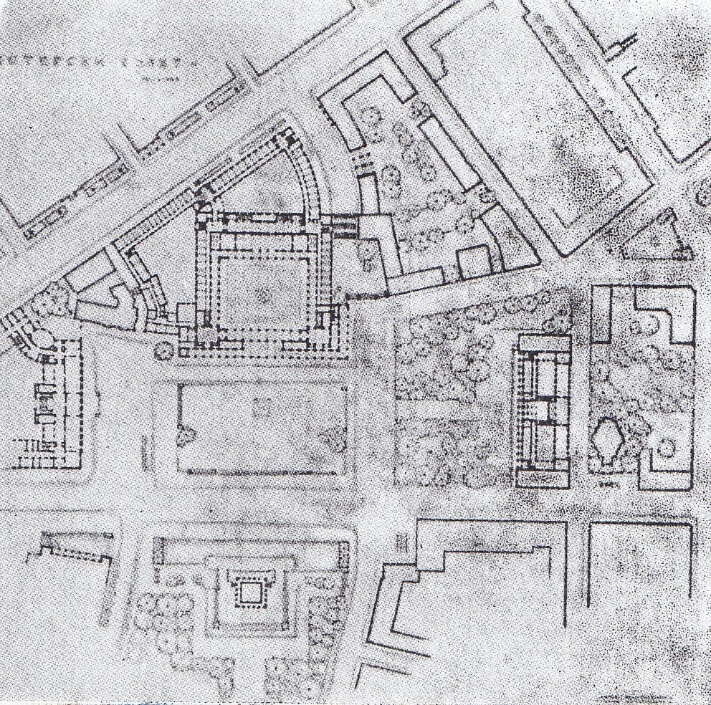
Two alternative projects for 9 September Sq from 1956, one of which (left) preserving the former palace and moving the Council of Ministers behind it
Source: Arhitektura 1/1956: 20
The House of the Soviets, the ensemble’s centerpiece, disappeared from the agenda, most likely due to its exorbitant cost.
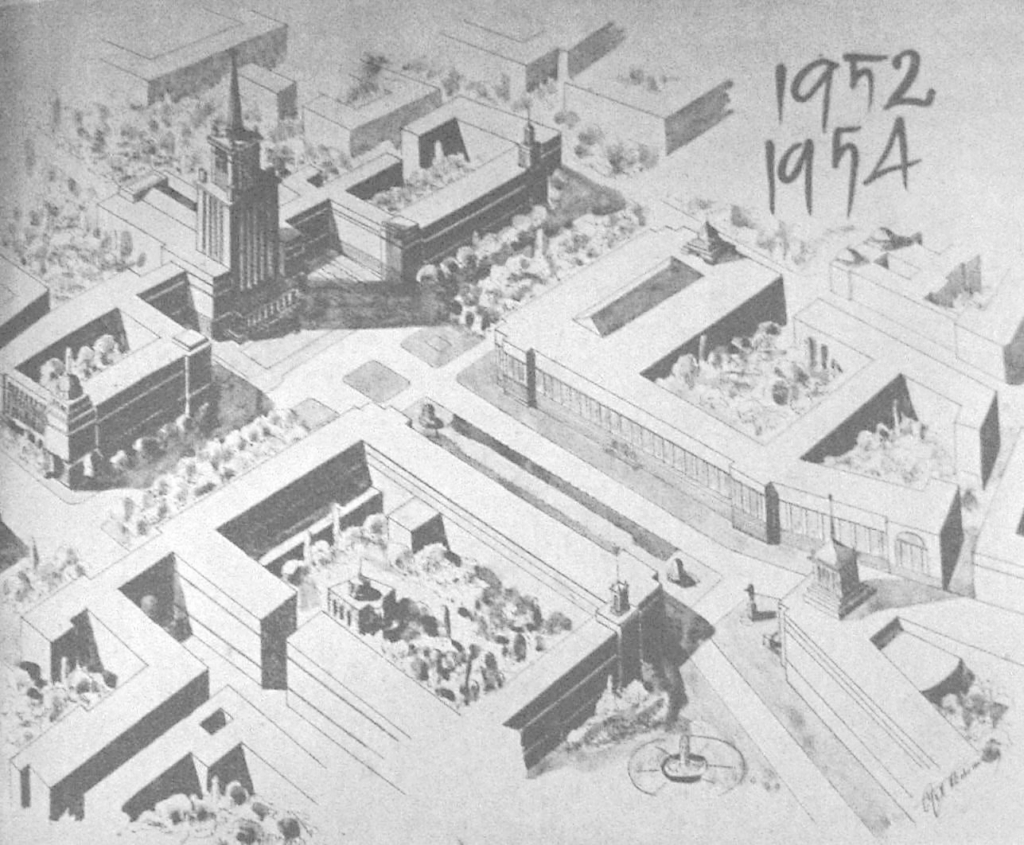
The plan of the entire Largo ensemble with the dominant, yet non-implemented structure of the House of the Soviets
Source: Serdika 1-3/1952: 21
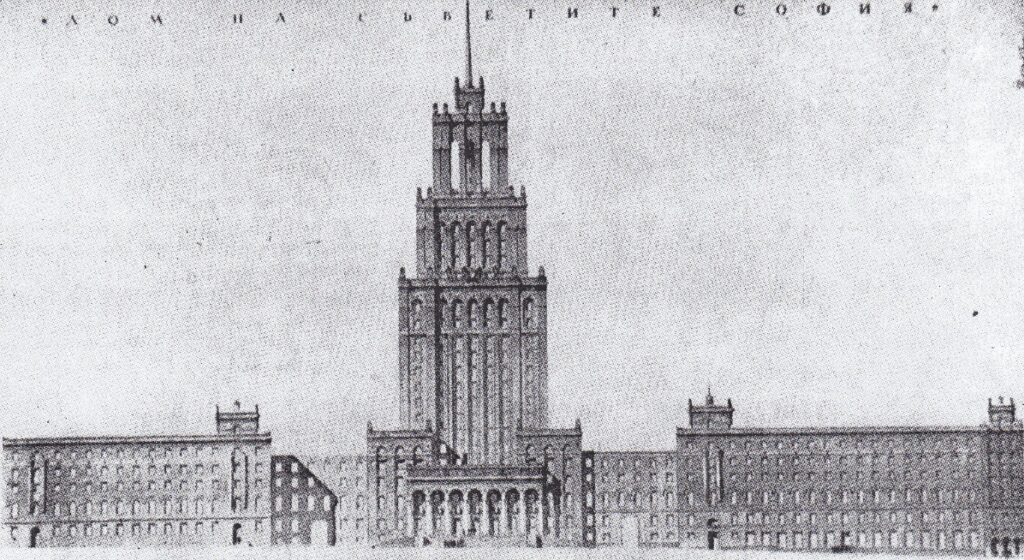
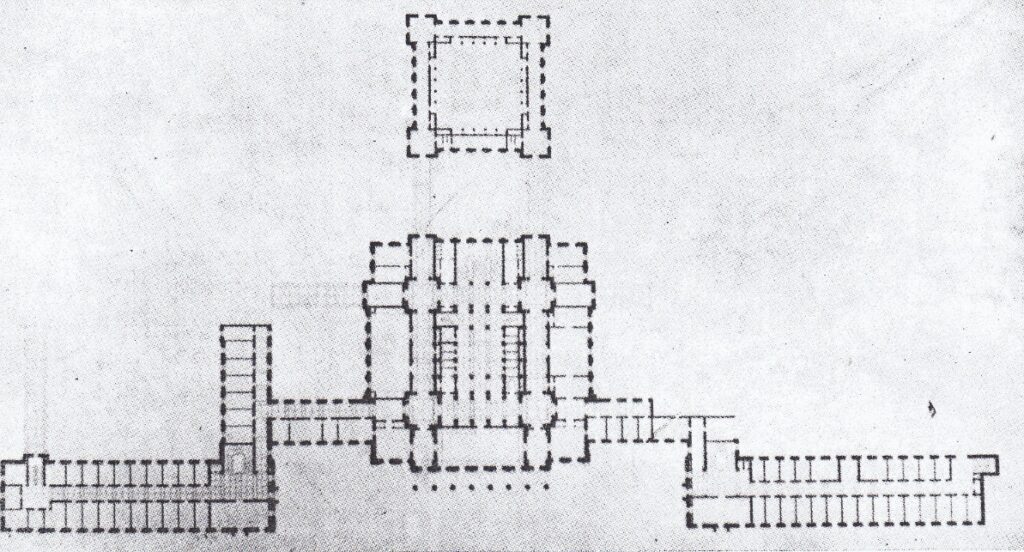
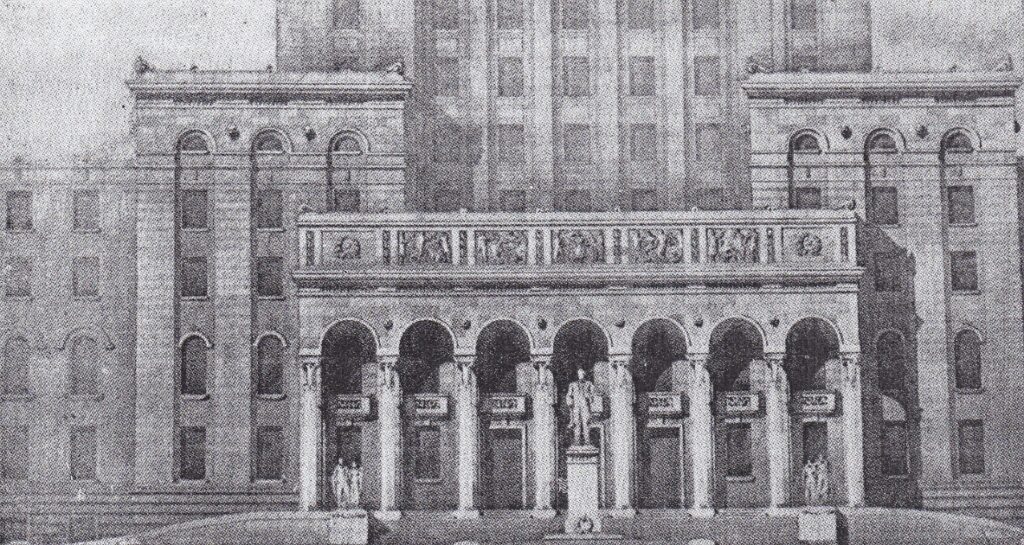
The project for the House of the Soviets
Source: Arhitektura 5-6/1954: 1-2
What was eventually built came fatefully late: Largo was inaugurated in 1957, shortly after Khrushchev’s secret speech set de-Stalinization in motion, and two years after the All-Union Congress on Construction and Architecture in Moscow had condemned the “excesses” of Stalinist monumentalism as a waste of economic and human resources. In 1960, architect Lyuben Tonev himself declared the failure to build the House of the Soviets the one “great success” of the entire enterprise.
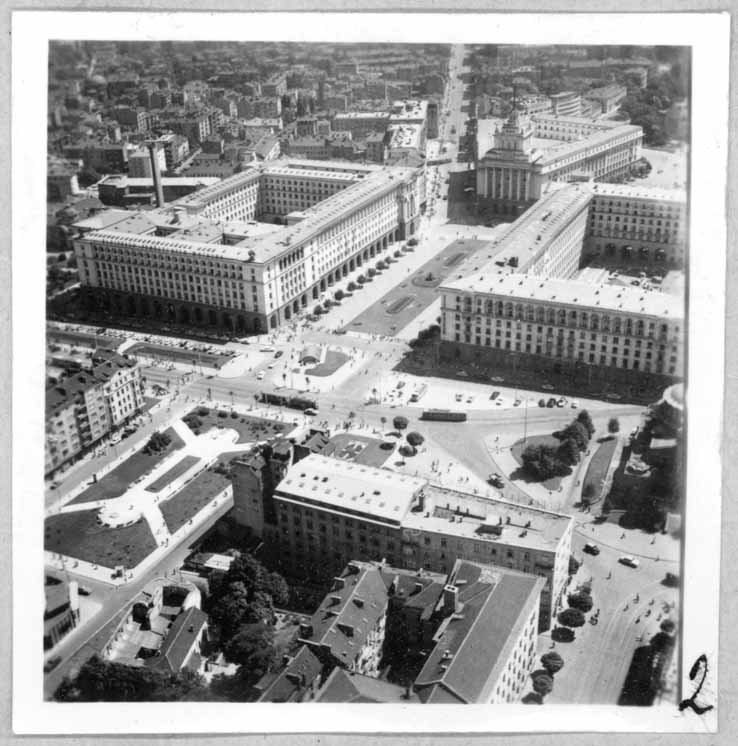
Largo completed
Source: Central State Archives of the Republic of Bulgaria (TsDA), album 85-5, photo 61/2418-2
Leaping forward to post-1989, Largo today seems to epitomize the failure of transition. After the ruby-red star atop the Party House was removed by helicopter in autumn 1990 — a widely publicized spectacle — the building became the seat of democratic Bulgaria’s parliament. A gargantuan structure designed as a literal ivory tower of power according to Stalinist principles was now expected to facilitate an entirely different relationship between state and citizens.
For more details, you can see my articles:
“Ideology and urbanism in a flux: Making Sofia socialist in the Stalinist period and beyond”, Southeastern Europe 41:2/2017: 112-40
“The dead body of the leader as an organizing principle of socialist public space: The Mausoleum of Georgi Dimitrov in Sofia”, in Maren Behrensen, Lois Lee and Ahmet S. Tekelioglu (eds), Modernities Revisited. Vienna: IWM Junior Visiting Fellows’ Conference, 2011