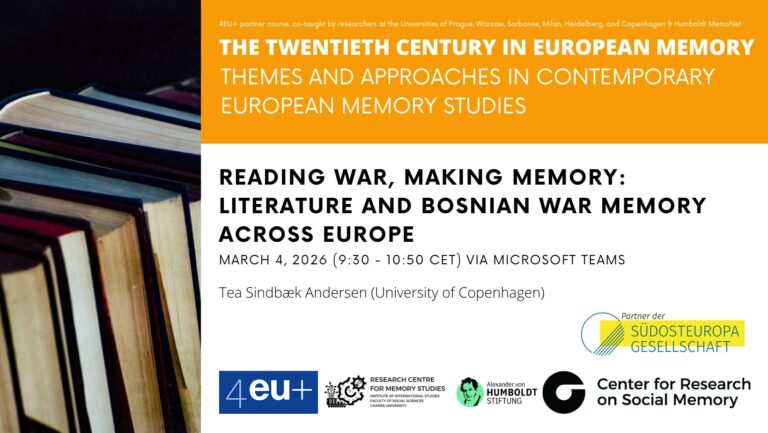
 The event will be held in MS Teams. Please register before the event. You should receive the link to join in your email. Registration Link: https://shorturl.at/q12tV
Organized by the Südosteuropa-Gesellschaft Parnerstelle in Prague, this seminar discusses the research behind the monograph Reading War, Making Memory (Berghahn 2025). It investigates how authors from the diaspora of the former Yugoslavia transmit the memory of the Bosnian war (1992-1995) in their fiction, and how these memories have been circulated and received by readers in Germany, Denmark, the UK, and Bosnia-Herzegovina. Combining close readings, studies of public reception, and focus group interviews with lay readers, this book explores the capability of literature to reshape social frameworks of memory and the wider impact of memory-making literature across Europe. The talk is delivered by Tea Sindbæk Andersen (University of Copenhagen).
This lecture is part of the course "The Twentieth Century in European Memory: Themes and Approaches in Contemporary European Memory Studies," and is open to the public. Speakers include researchers from 4EU+ partner universities and the Humboldt MemoNet, working across disciplines such as history, literary studies, cultural studies, political science, anthropology, and heritage studies. Across the series, lectures address themes including war and post-conflict memory, affect and care, heritage and infrastructure, environmental and nuclear memory, literature and film, marginalised and non-hegemonic remembrance, and the political uses of the past. Each session consists of an expert lecture followed by a moderated Q&A. While the course is designed for enrolled students, individual lectures are open to the public.
Next sessions (all 09:30 - 10:50):
- 11.03.2026 – “It Was a Nice Atmosphere”: Affective Atmosphere, Memory, and Inpatient Care Beyond Institutional Narratives – Verusca Calabria (Nottingham Trent University): Examines affective labour in British psychiatric inpatient settings, showing how non-clinical voices and practices contribute to historical memory of care and sociability.
- 18.03.2026 – Confronting the Past: Memory, Legacy, and Peace in Northern Ireland – Chris Reynolds (Nottingham Trent University): Discusses contested pasts in Northern Ireland and how memory studies support dialogue, reflection, and sustainable peace.
- 25.03.2026 – Memory of Railway Stations: The Strange within the Familiar – Luba Jurgenson (University of Sorbonne): Investigates how deportation stations are transformed into heritage sites and how proximity-based “railway memory” shapes understanding of violence in everyday spaces.
- 01.04.2026 – Nuclear Heritage: Remembering Toxic Pasts – Juliane Tomann (University of Regensburg): Explores how nuclear legacies are turned into heritage, including landscapes of toxicity, human and non-human actors, and symbolic remediations.
- 08.04.2026 – Temporal Emotions: Affective Governance of Memory in Central and Eastern Europe – Jogilė Ulinskaitė (Vilnius University): Examines how historical events are used politically to evoke emotions, construct narratives, and mobilize support in Central and Eastern Europe.
- 15.04.2026 – Performing Memory: Empty Chairs as "Nonuments" – Pietro Conte (University of Milan): Focuses on participatory practices and “nonuments” that engage communities, transforming memory from passive to performative experiences.
- 22.04.2026 – Transoceanic Memory. Environment, Narrative and Temporality in Anglophone Literature – Hanna Teichler (Goethe University Frankfurt): Explores how memory and the Anthropocene intersect in literature, using environmental formations to frame identity and memory across oceans.
- 29.04.2026 – Where Can Margins of Memory Take Us? Theorising Cultures and Politics of Non-Hegemonic Remembrance – Volha Bartash and Tatiana Klepikova (University of Regensburg): Studies memory cultures of marginalized groups and theorizes non-hegemonic remembrance across multiple scholarly lenses.
- 06.05.2026 – Screen Memory or Memory on the Screen? Western Balkans Cinema since 2000 – Christian Voss (Humboldt University Berlin): Reviews films and series from the Western Balkans and how cinema addresses war trauma, nationalism, and historical revisionism.
- 13.05.2026 – Theories of Historical Analogies – Paweł Dobrosielski (University of Warsaw): TBA
- 20.05.2026 – Paleomemories: From Prehistoric Caves to Digital Narratives – Margherita Fontana (University of Milan): Examines prehistoric art, cave heritage, digital twins, and how mediated memory reconstructs inaccessible pasts.
- 11.03.2026 – “It Was a Nice Atmosphere”: Affective Atmosphere, Memory, and Inpatient Care Beyond Institutional Narratives – Verusca Calabria (Nottingham Trent University): Examines affective labour in British psychiatric inpatient settings, showing how non-clinical voices and practices contribute to historical memory of care and sociability.
- 18.03.2026 – Confronting the Past: Memory, Legacy, and Peace in Northern Ireland – Chris Reynolds (Nottingham Trent University): Discusses contested pasts in Northern Ireland and how memory studies support dialogue, reflection, and sustainable peace.
- 25.03.2026 – Memory of Railway Stations: The Strange within the Familiar – Luba Jurgenson (University of Sorbonne): Investigates how deportation stations are transformed into heritage sites and how proximity-based “railway memory” shapes understanding of violence in everyday spaces.
- 01.04.2026 – Nuclear Heritage: Remembering Toxic Pasts – Juliane Tomann (University of Regensburg): Explores how nuclear legacies are turned into heritage, including landscapes of toxicity, human and non-human actors, and symbolic remediations.
- 08.04.2026 – Temporal Emotions: Affective Governance of Memory in Central and Eastern Europe – Jogilė Ulinskaitė (Vilnius University): Examines how historical events are used politically to evoke emotions, construct narratives, and mobilize support in Central and Eastern Europe.
- 15.04.2026 – Performing Memory: Empty Chairs as "Nonuments" – Pietro Conte (University of Milan): Focuses on participatory practices and “nonuments” that engage communities, transforming memory from passive to performative experiences.
- 22.04.2026 – Transoceanic Memory. Environment, Narrative and Temporality in Anglophone Literature – Hanna Teichler (Goethe University Frankfurt): Explores how memory and the Anthropocene intersect in literature, using environmental formations to frame identity and memory across oceans.
- 29.04.2026 – Where Can Margins of Memory Take Us? Theorising Cultures and Politics of Non-Hegemonic Remembrance – Volha Bartash and Tatiana Klepikova (University of Regensburg): Studies memory cultures of marginalized groups and theorizes non-hegemonic remembrance across multiple scholarly lenses.
- 06.05.2026 – Screen Memory or Memory on the Screen? Western Balkans Cinema since 2000 – Christian Voss (Humboldt University Berlin): Reviews films and series from the Western Balkans and how cinema addresses war trauma, nationalism, and historical revisionism.
- 13.05.2026 – Theories of Historical Analogies – Paweł Dobrosielski (University of Warsaw): TBA
- 20.05.2026 – Paleomemories: From Prehistoric Caves to Digital Narratives – Margherita Fontana (University of Milan): Examines prehistoric art, cave heritage, digital twins, and how mediated memory reconstructs inaccessible pasts.