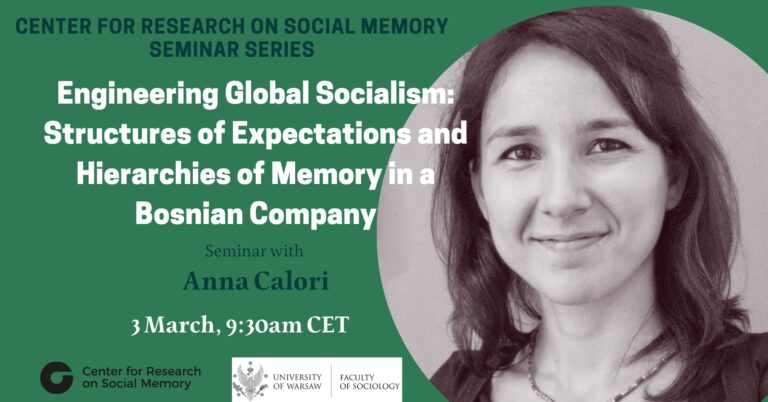
Engineering Global Socialism: Ownership, Non-Alignment, and Corporate Culture in a Bosnian Company | Seminar with Anna Calori
2026-03-03
09:30
- ONLINE
- English
>>>See the event recording here.<<<
We are delighted to invite you to our second online MEPOST seminar which will feature a presentation of the recently released book Engineering Global Socialism: Ownership, Non-Alignment, and Corporate Culture in a Bosnian Company (Indiana University Press, 2026) by Dr Anna Calori (University of Glasgow). The seminar will take place online on 3 March at 9:30 am (CET) via Zoom.
Engineering Global Socialism: Structures of Expectations and Hierarchies of Memory in a Bosnian Company
#2 MEPOST seminar description:
This seminar will depart from Anna Calori's new book, Engineering Global Socialism: Ownership, Non-Alignment and Corporate Culture in a Bosnian Company, and will be oriented towards the main topics of the MEPOST project: the economics of transition, communicative memory, and the emotions attached to memories.
Engineering Global Socialism chronicles the journey of the Bosnian global corporation Energoinvest and its workers from its Yugoslav socialist ideals through decades of dissolution, reconstruction, and post-socialist transformation. Tracing the long trajectory of a Yugoslav enterprise through decades of large-scale social change, Calori will present a historical and sociological moment in which workers’ ideas about social and corporate enterprise offered the possibility of a more democratic path to globalization.
Short biography:
Dr Anna Calori has been a lecturer in contemporary economic history at the University of Glasgow since September 2023. Before joining the university, she was a researcher at the Research Centre for the History of Transformations at the University of Vienna, where she was awarded a three-year postdoctoral fellowship funded by the Marie Skłodowska-Curie COFUND initiative (REWIRE – Reinforcing Women in Research). She has published work on the history of non-alignment and economic cooperation during the Cold War.
The MEPOST project received funding from the Research Council of Lithuania (LMTLT), agreement No S-LL-25-5, and the National Science Center (Poland), agreement No 2024/52/L/HS2/00283.